


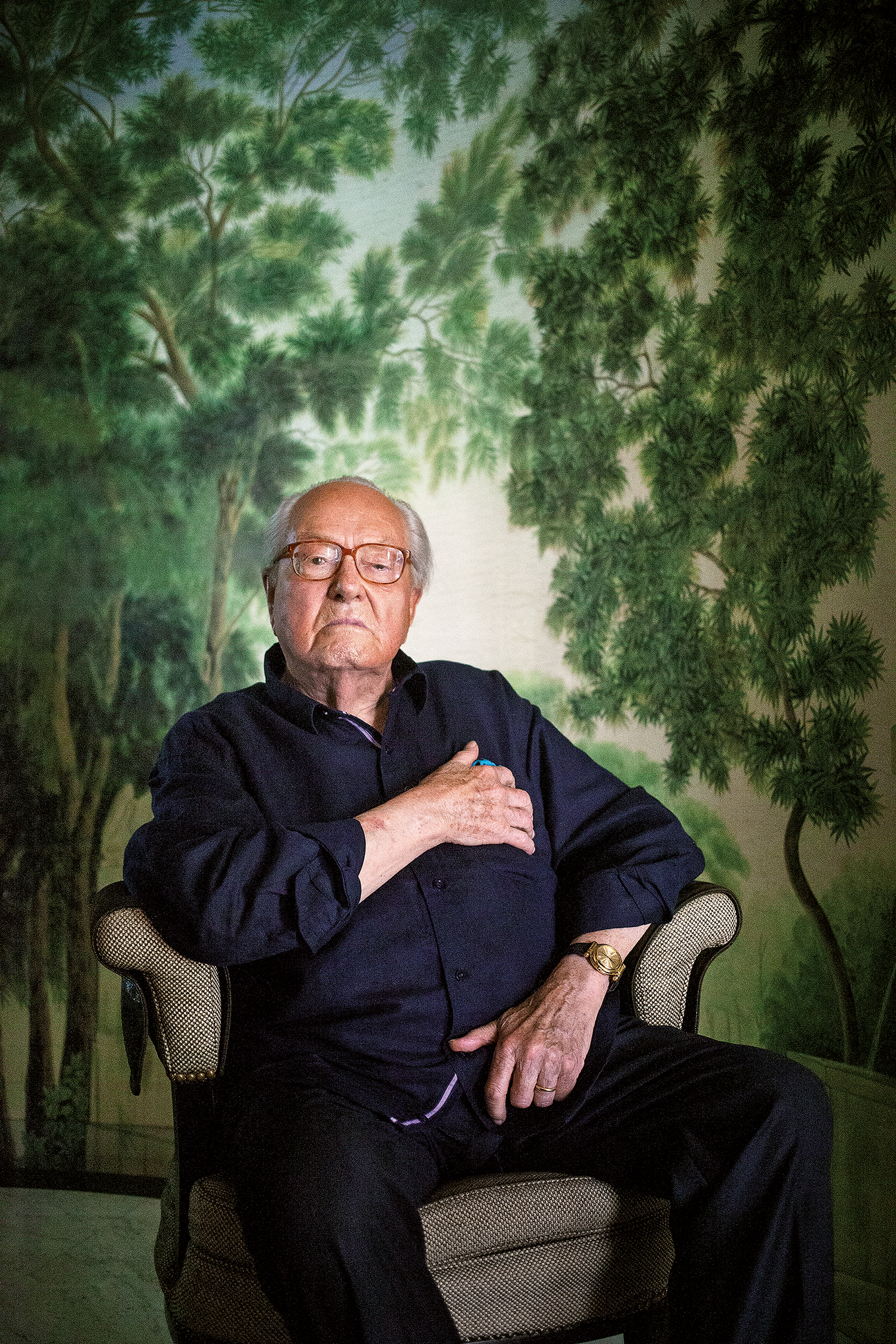
Jean-Marie Le Pen at his home, 26 June 2019 © Rémy Artiges.
With the polls predicting an election win for the Rassemblement Nationale next April, France’s far right is closing in on power. Rémy Artiges discusses photographing the party’s founder Jean-Marie Le Pen, from his first inklings of success to his later years.
France’s next presidential election is scheduled for April 2027 and so far the polls indicate Rassemblement Nationale will win; if so it will be the first time the far right has been in power in France since 1945, and the impact will ripple across Europe and beyond. “It’s a mess!” says Rémy Artiges. “French politics is super divided at the moment, and I am sure that the traditional right wing would prefer to join the far right than the far left [in the event of a coalition]. So the RN could win next year.”
It has been a long road for the RN, which was known until 2018 as Le Front National. It started in 1972, when the neo-fascist Ordre Nouveau joined with Jean-Marie Le Pen’s growing political movement; already a veteran of far-right politics, who had called for collaborationists to be rehabilitated, Le Pen headed the party from the start. Standing in the French presidential election of 1974, he won just 0.74 per cent of the vote, but in the intervening time the political centre has shifted. And while similar shifts have occurred the world over, in France this move is particularly associated with Le Pen. In fact the process of mainstreaming far-right-wing thinking was dubbed ‘la lepénisation’ in the 1980s.
Le Pen’s daughter Marine took over in 2011 and claimed to ‘de-demonise’ the party, expelling her father in 2015 after he (again) described the Nazi gas chambers as a “detail” of World War Two. Marine renamed the party and RN is now described as ‘populist right’ by some outlets, though it is still accused of promoting xenophobia, especially Islamophobia. In 2018 Steve Bannon, former adviser to Donald Trump, gave a speech to RN members, stating: “Let them call you racist, let them call you xenophobes, let them call you nativists. Wear it like a badge of honour. Because every day, we get stronger and they get weaker… History is on our side and will bring us victory.” The members gave him a standing ovation.
“The far-right movement and neo-fascists have won in many ways all around the world,” observes Artiges. “Even if they’re not directly in power, their politics is the centre of attention.”
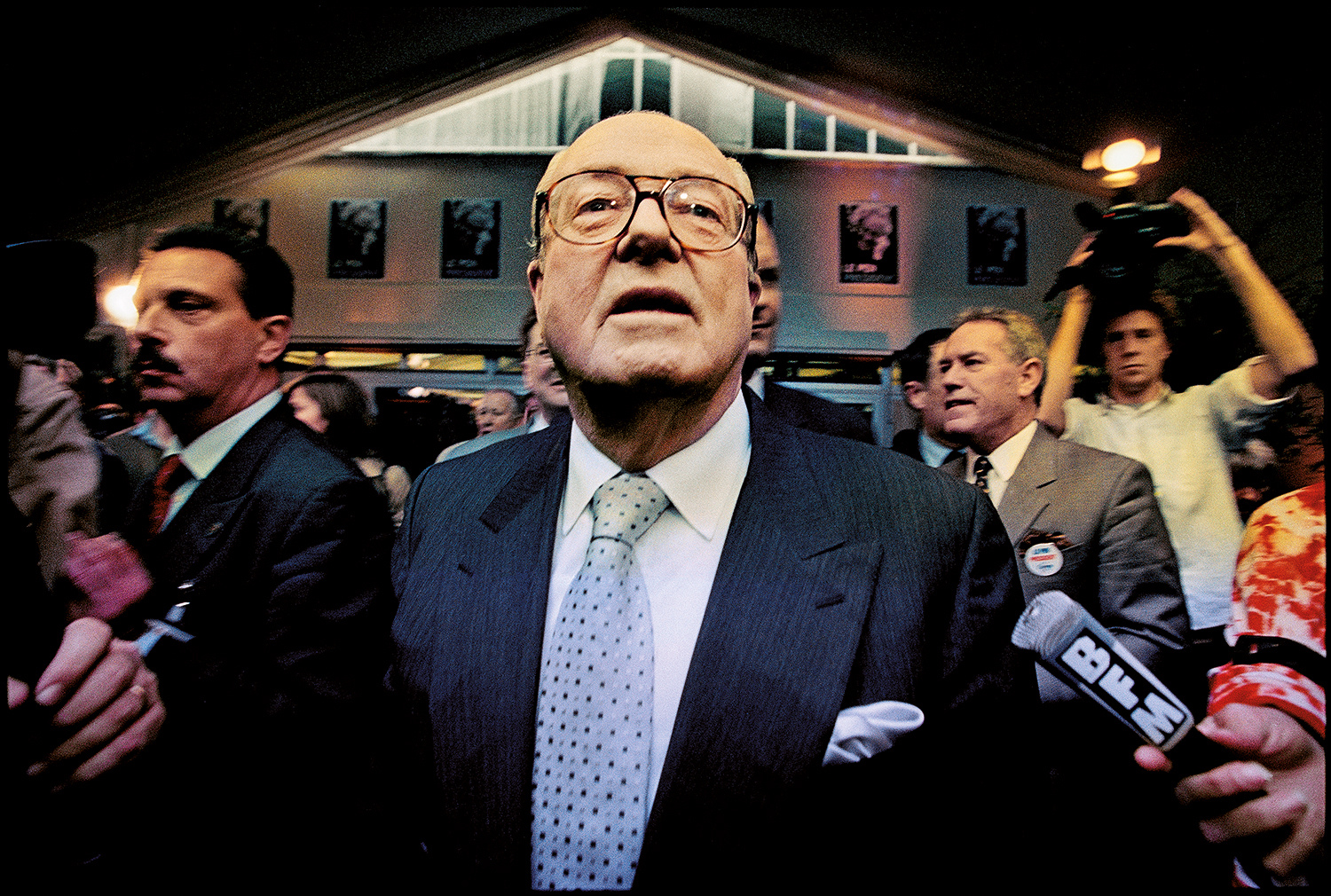
“The far right movement and neo-fascists have won in many ways all around the world. Even if they’re not directly in power, their politics is the centre of attention” – Rémy Artiges
Artiges first met Jean-Marie Le Pen in 2002, after being sent to photograph him by left-leaning newspaper Libération during another presidential election campaign. Initially Artiges refused the assignment, “because the closer you get, the more impacted you are”, and because of an ongoing debate about publicising Le Pen and his ideas. “At that time Jean-Marie Le Pen was considered unacceptable by most of the political and media community,” Artiges explains. “What he was saying was way beyond the limit of the law, he was taken to court so many times for antisemitism, racism, and negationism [for example, Holocaust denial]. So people did not want to give him space. There was an ethical issue, ‘Do you want to give space to his horrible thoughts?’”
Le Pen had complained about this exclusion in the early 1980s, writing to President Mitterrand to protest the “media boycott” against his party; the president instructed the main television channels to give the FN equitable coverage, and in February 1984 Le Pen appeared on prime-time TV for the first time. He later described this as “the hour that changed everything”, and his charisma and sheer force of personality immediately attracted attention among voters. “He was before social media, from another century, but he had that same ability to occupy space,” says Artiges. “Whatever he said, he said loud and proud because he really believed in it all. But he also wanted to shock you. That was his way to operate. He was like a black hole sucking in the light.”
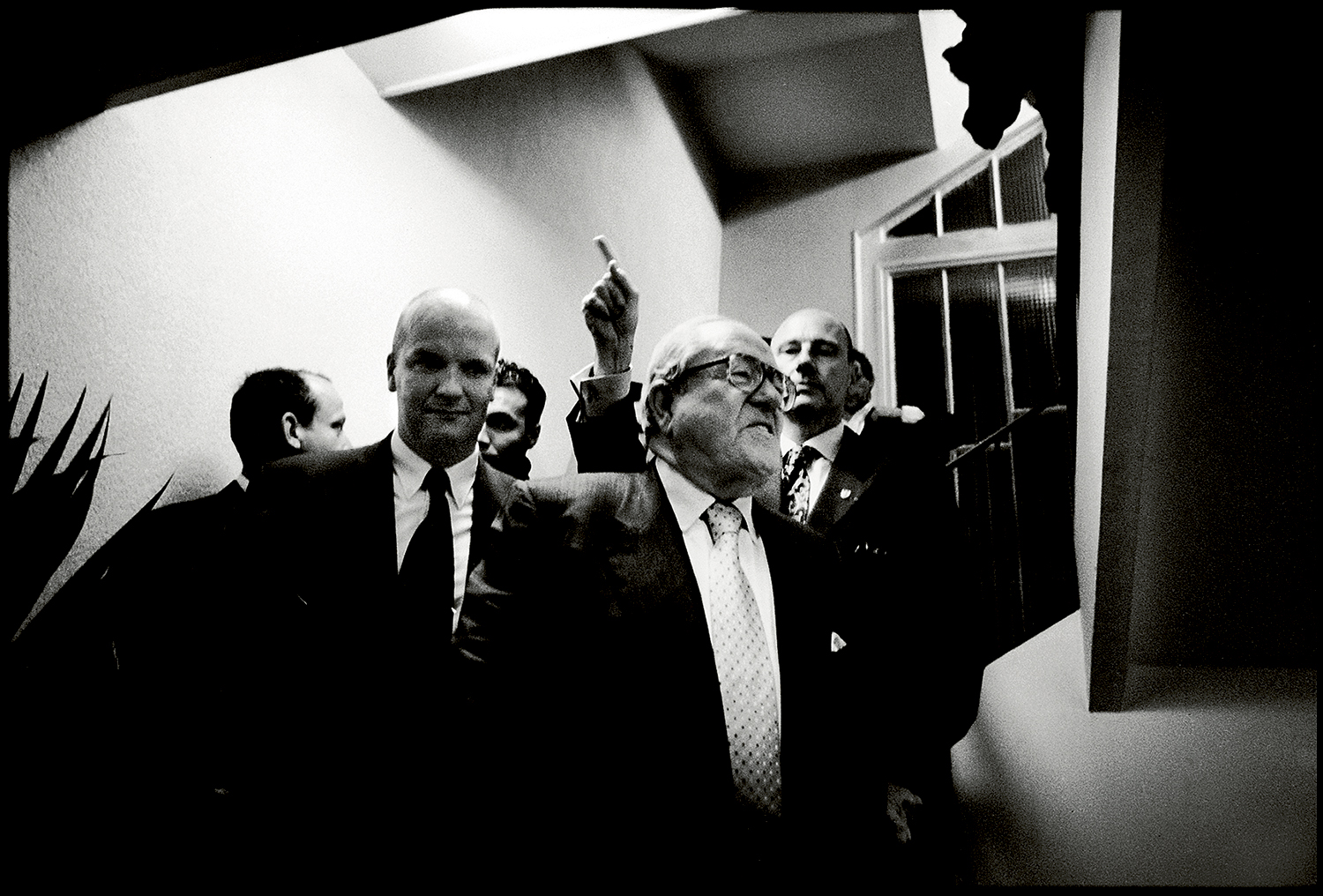
Artiges agreed to cover Le Pen’s campaign but stick to straight documentary, shooting exactly what he saw, not portraits or caricature. When he arrived he found he and his fellow photojournalists were uninspired, most of them just doing the job. Then, on the very first day, there came a shock. Le Pen had won an unexpected 16.86 per cent of the first round vote – second place after the incumbent President Jacques Chirac, and enough to go through to the second round. It was the first time someone so far to the right had got that far in France, and a major political event. Artiges’ images capture some of the visceral reaction in the FN camp.
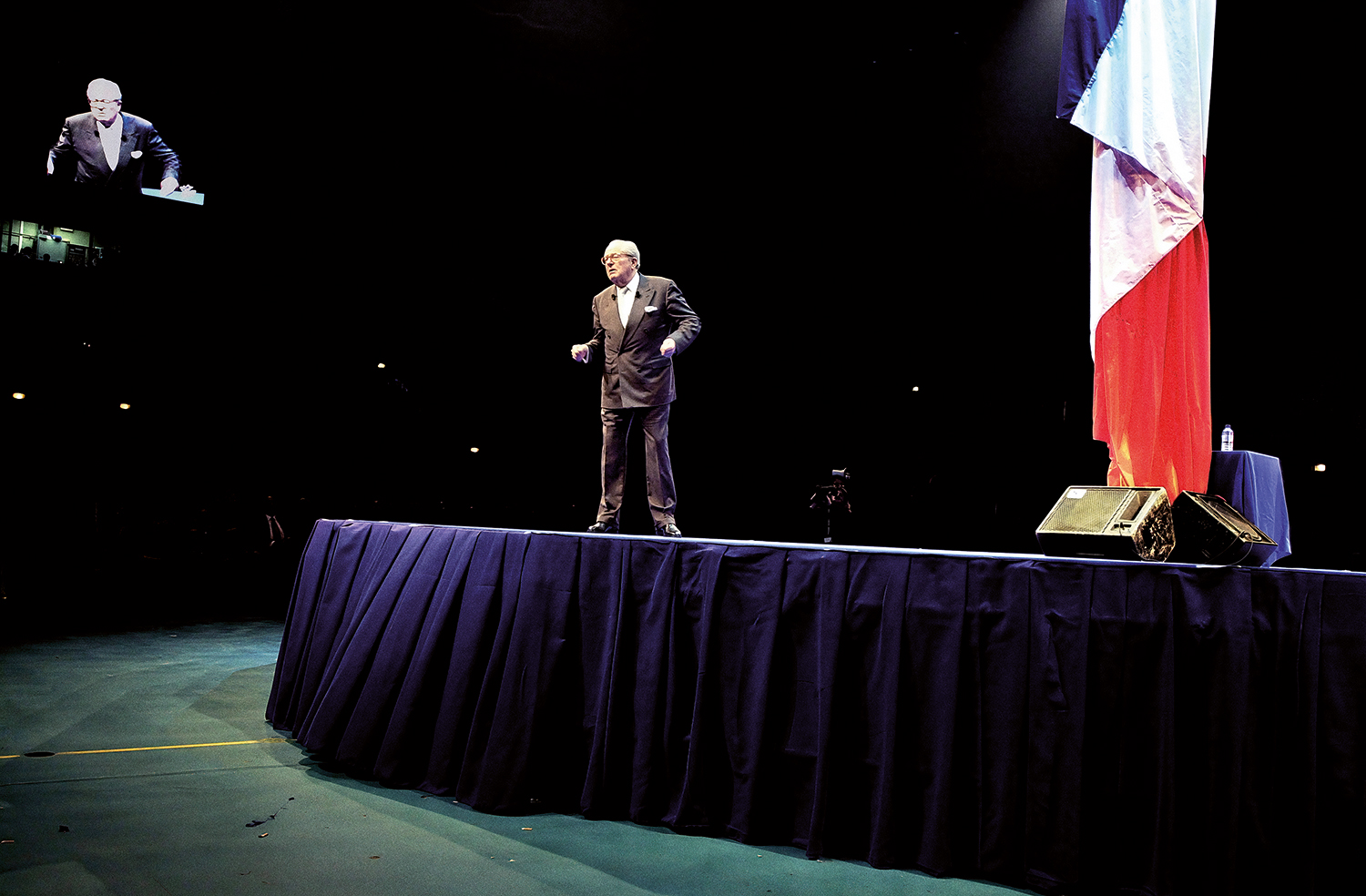
“They were hysterical!” he says. “Super, super happy because finally their ideas were being recognised. Previously Le Pen had been kind of a political outcast, now they could see some power. So they were overjoyed, but also there was a sense of violence. In general they weren’t polite, especially to me because I was from Libération and that wasn’t their favourite paper. But I believe physical violence, men who play on their physical abilities, is part of the far right. It’s part of the deal.”
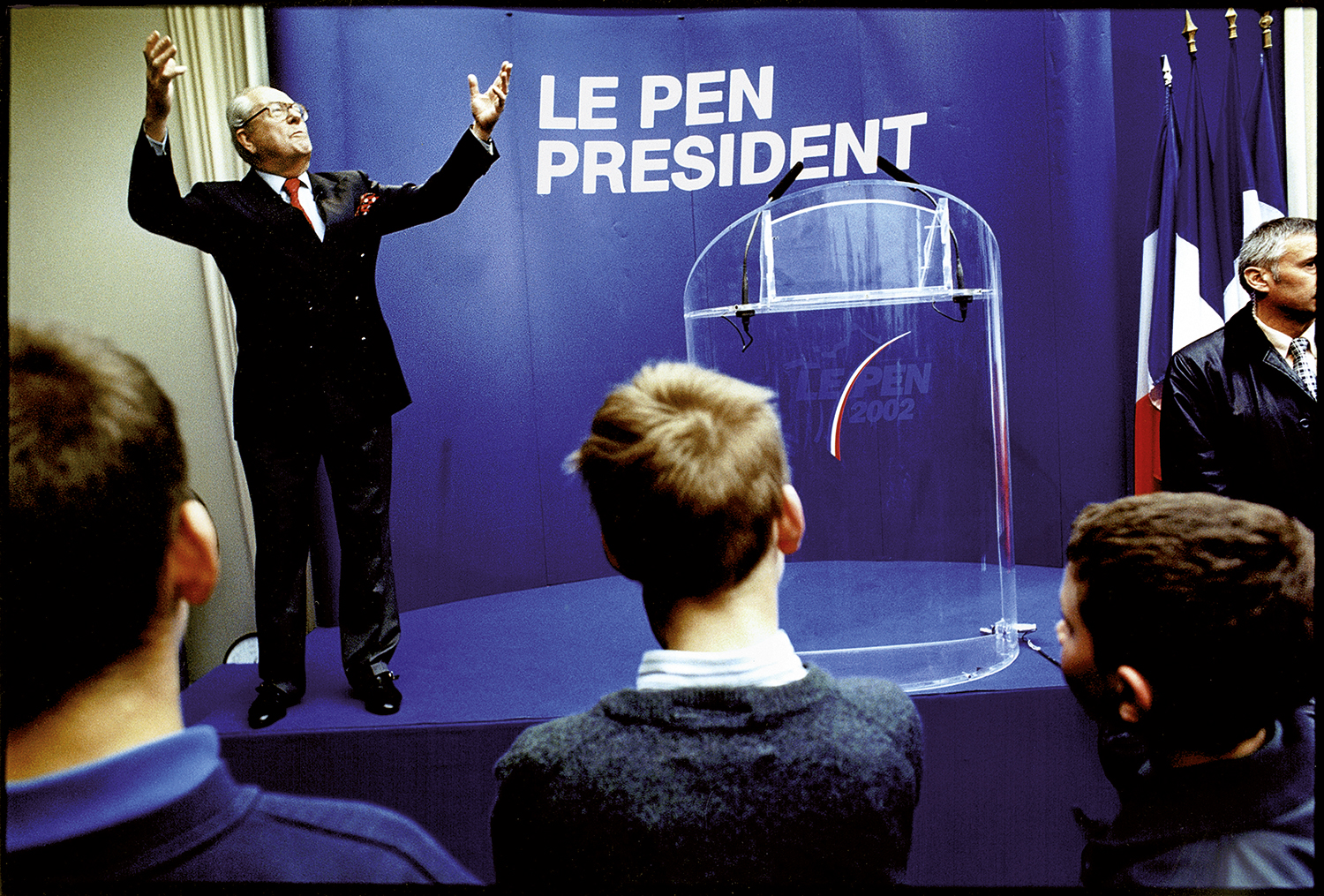
Artiges stayed with the FN campaign, still trying to simply document; his images capture the media circus around Le Pen, the microphones amplifying his thoughts and policies, the political posters declaring him president. A low point was photographing an event at which a group of kids watched admiringly as Le Pen spoke, he says. Wider public opinion was united against Le Pen, however, and parties across the political spectrum joined together to campaign against him for the second vote. Slogans circulated such as ‘A crook is better than a fascist’ (‘Un escroc mieux qu’un facho’) and ‘Graft rather than hate, Chirac rather than Le Pen’ (‘L’arnaque plutôt que la haine, Chirac plutôt que Le Pen’) and – while anti-Le Pen rather than pro-Chirac – they helped the standing president win 82 per cent of the vote, the biggest majority since the Fifth Republic was established in 1958.
Artiges photographed the FN until the end of the election then told Libération he would stop; more widely, Le Pen once again exited the limelight. The following years saw the politician revert to bête noire, especially after his daughter became leader and expelled him from the party. In 2017 Marine reached the second round in the presidential election, winning 33 per cent of the vote, then in 2019 Jean-Marie Le Pen announced he would retire, and Libération asked Artiges to shoot him again. This time the deal was different, the newspaper requesting a formal portrait to accompany a written interview, and Artiges keenly aware he was photographing a 90-year-old. “I had the same reservations as before, and he hadn’t changed,” he says. “But I felt I had to pay attention to the fact that he was an old man. I wasn’t going to shoot the ambulance [kick someone when they were down].”
Le Pen welcomed the publicity; he still had that sense of ego, Artiges says, the desire to be centre of attention. Artiges and the writer Tristan Berteloot went to Le Pen’s home in a wealthy suburb and – while not the home built by Napoleon III, given to Le Pen by a French industrialist in 1977 – it was lavish. In fact it was “over-decorated and over-lit”, says Artiges, and it was a hot day so all the shutters were closed. Faced with electric lighting and an elderly subject who needed to sit for the shoot, his first concerns were “empirical” questions around how to make a portrait at all. Finding a bucolic mural, he instinctively used it as a backdrop; posing in front with a black shirt and grim expression, Le Pen somehow embodies curmudgeonly ire.
“It’s the contrast between the pastoral, green background and Le Pen,” says Artiges. “I put him in a comfortable situation but he can’t help himself. I took another portrait in front of a painting but it’s less disturbing, I think because the blue background is more relatable. But it’s still interesting because it features dogs that look like something northern European, even Aryan, and that was in his home.”
Two years later Artiges was invited to photograph Le Pen again, as Marine and the party he had founded reached the second round of the presidential election once more. Le Pen was now in declining health, having had a heart attack earlier in 2022, but his iron will – and infamous charisma – were undiminished. The images look like reportage but were actually carefully stage-managed by Le Pen and his team, says Artiges; his apparently candid shots of Le Pen holding forth over a drink were closely duplicated by other photographers surveying the scene because, positioned in front of the politician like an audience, they were encouraged to watch him perform. Another image shows Le Pen and his wife watching TV as the second round vote was announced; the screen shows Macron winning, as had been predicted. Artiges suspects Le Pen wanted the press to record his daughter’s defeat.
At the same time, this photograph also records a near miss. Marine had won 42 per cent in the second round, a once unthinkable result for the party Le Pen founded and maybe a promise of more to come. “If we gain 10 points every [presidential election], next time, we’ll win,” noted Marine’s protege, Jordan Bardella, on French TV. Le Pen was backing Eric Zemmour not Marine, but perhaps was gratified nonetheless.
These images were some of the last taken of Le Pen, who died in 2025. The man has passed away, but his politics, ideas and images live on. “The media has a responsibility in constructing power through representation, it’s undeniable,” says Artiges. “Otherwise media moguls such as Rupert Murdoch and Vincent Bolloré would not devote so much effort to shaping public opinion… What surprises me is that, despite the many examples of abuse, failure, and the arbitrariness that often accompanies it, power itself is not being challenged more seriously. It no longer seems implausible that Donald Trump might refuse to leave office at the end of his second term; the man who performed a fascist salute at his inauguration remains the richest person on Earth.
“There are voters in France who sincerely believe a 30-year-old man represents the solution to their problems. Today his name is Bardella; yesterday it was Macron. And even though their ideas are not equivalent, their political projects differ, the hope, fervour and even adoration they inspire are remarkably similar.”