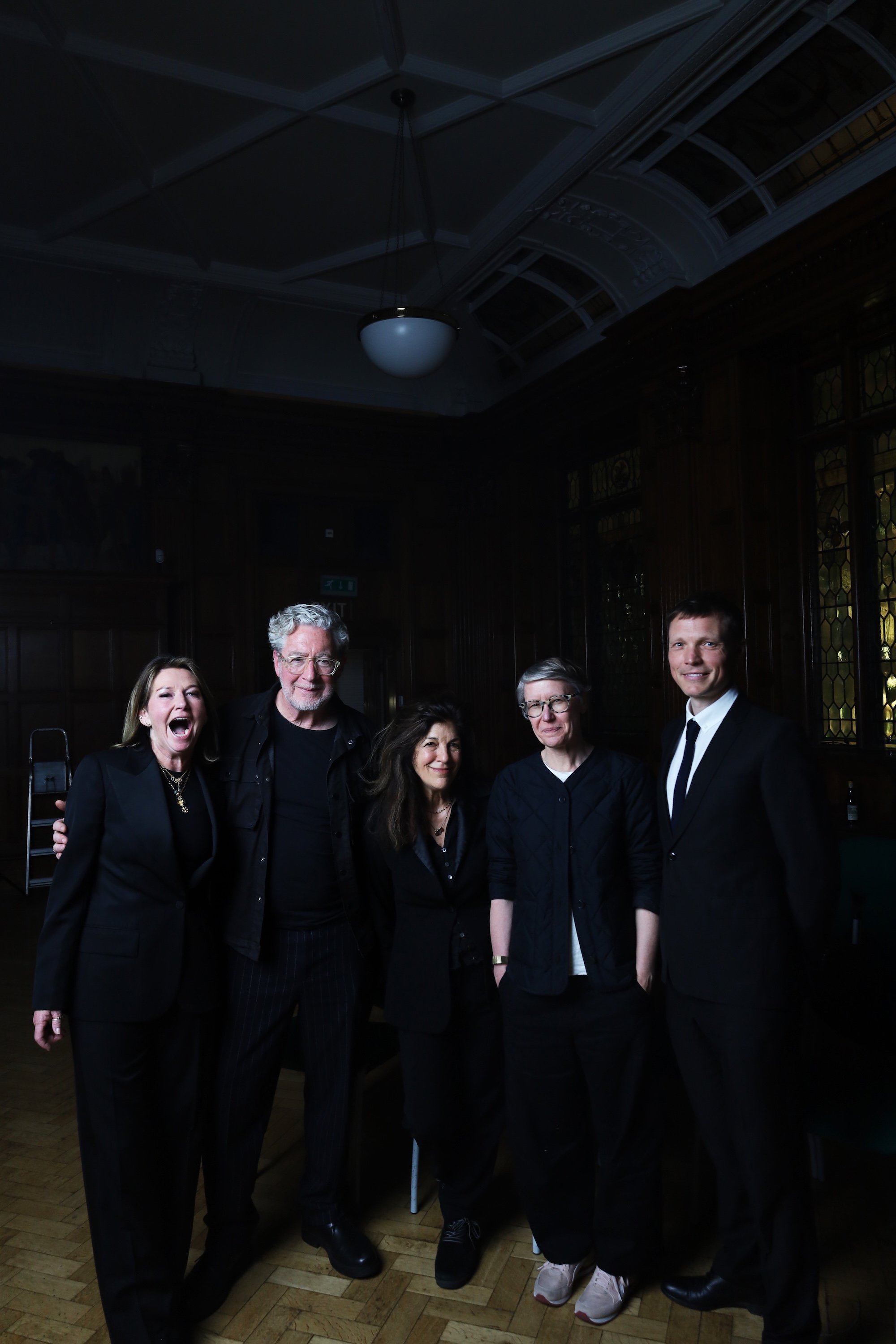


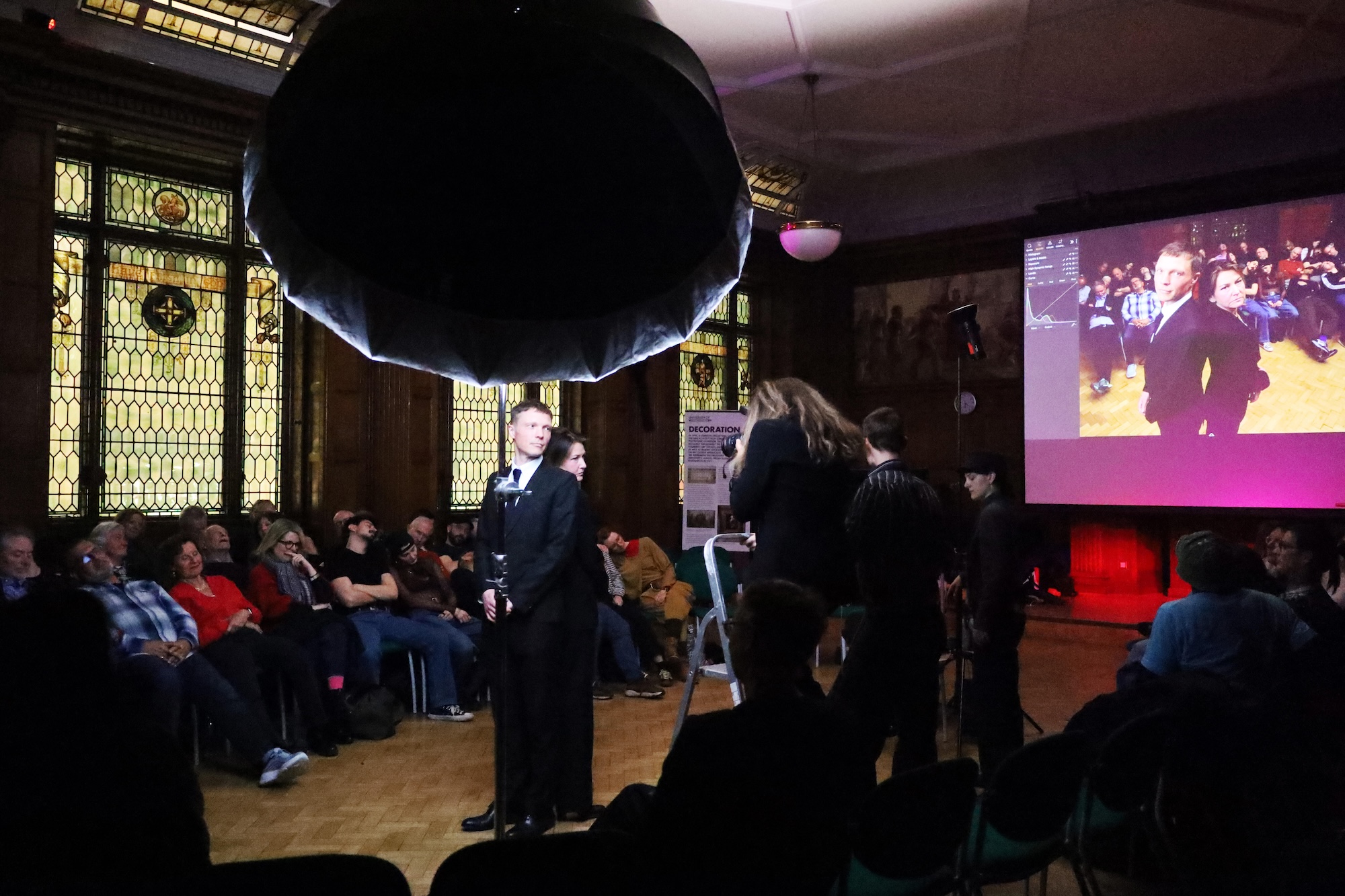
Shoot in progress © Charlotte Hull
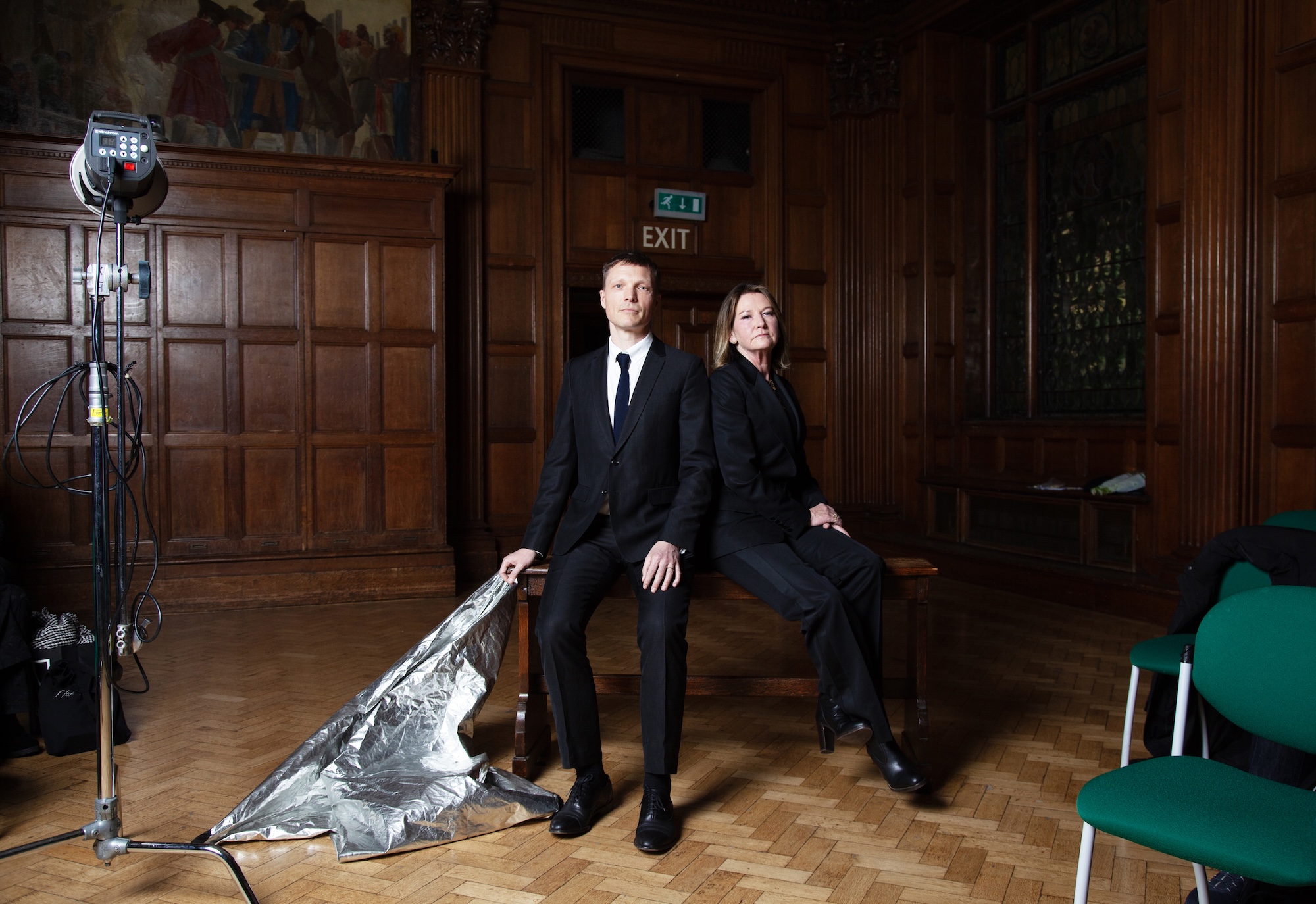
The new issue of BJP features a portrait of Harriet Logan and Tristan Lund, made by Jillian Edelstein in a public photo shoot arranged by Dr David Moore at the University of Westminster. Here Moore explains how this event came about – and why he wanted to do it
Back in February, photographer and artist, Dr David Moore contacted BJP with an interesting proposition; as Principal Lecturer for photography at the University of Westminster, he had devised an event in which a photographer would do a portrait shoot in front of an audience, in the university’s historic Fyvie Hall. He had already found a willing photographer in Jillian Edelstein, who is known for her hard-hitting work Truth and Lies – Stories from The Truth and Reconciliation Commission in South Africa, and wanted to invite BJP to the evening. But he didn’t have a subject, so also asked if BJP could think of someone.
Ideally he asked if BJP knew of two willing participants in fact, as Edelstein has been working on a long-term project making portraits of creative collaborators, titled Affinities and soon to be published by GOST; by coincidence BJP had just interviewed Harriet Logan and Tristan Lund, who have worked together on The Incite Project for nearly 15 years, building a collection of prints relating to war and conflict. BJP needed a photograph of the duo for the article but, despite their long collaboration – and friendship – the pair didn’t have one. On approaching Logan and Lund, it turned out they already knew Edelstein well, and had even added some of her work to The Incite Project. So, while apprehensive about the live aspect of the shoot, they readily agreed to get involved.
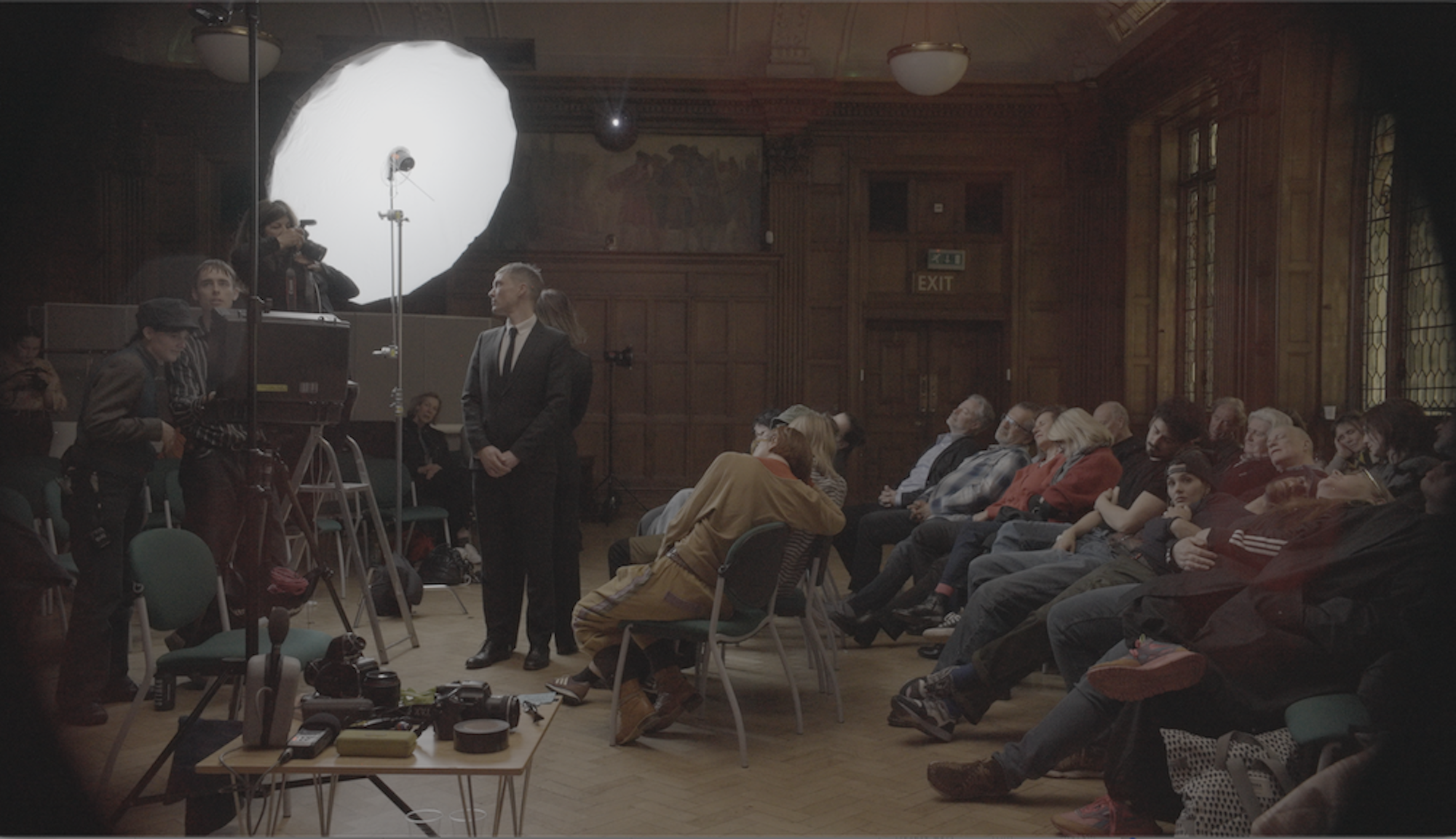
Performing Photography! took place on the 31 March; Edelstein shot with a camera tethered to a laptop and a large screen, on which the audience and her sitters could see the images in real time. Negotiating a delicate balance between controlling the shoot, responding to her subjects, and – in this case – engaging with the audience, Edelstein worked for over an hour. The event was also photographed by Charlotte Hull and Adham El-Khodary, and, in a nice twist, Logan is also a photographer, who won the Ian Parry Photojournalism Grant early on in her career.
“Everything came together very serendipitously,” smiles Moore. “It’s an event I’ve been wanting to stage for a long time, and I was waiting for the circumstances to appear. I am very grateful to Jillian, because I had asked other photographers and they had refused; obviously the photographer was the main focus of the event. But the way it developed on the night was also unexpected and interesting.”
“The idea is of questioning the conditions pressing upon the circumstances of production of photographs.” Dr David Moore
Performing Photography! was part of the University of Westminster’s ongoing Photoforum series, which Moore curates; designed to bring leading practitioners into dialogue with the public and students, Photoforum is usually a more conventional – though rewarding – event in which an image-maker, curator, or sometimes publisher, discusses their work. Performing Photography! was a project close to Moore’s heart, however, because of his ongoing interest into how photography is socially constructed and made.
“I’ve always been interested in how representation is formed,” says Moore. “A portrait shoot is a dialogical space, with questions of how one resolves something in a constrained time, how one negotiates the power balances, how one contributes to a whole range of social and visual needs. In this case, I wanted to set up a scenario which was an allegory for the medium itself, which asked the audience to think about what’s real and what’s constructed, and to what extent the event was performed.
“One of my favourite bits was at the beginning, before we started, when people were walking through the set itself – a space which would be turned into a photograph, in which they had to step over wires, and were not sure what was going on or whether they could speak with the team,” he continues. “I enjoyed that uncertainty very much. I also enjoyed the audience participation, which I had not anticipated at all. Someone shouted to ask Harriet why she didn’t smile and she pushed back, saying ‘I’m not smiling. I’m a serious person’. There was this totally unforeseen attempt to control the narrative and conform to expectations, which was fascinating.”
The project fed into Moore’s deeper research into photography, performance, and reality, which he has explored in various ways. He has interviewed several portrait photographers about their practice – “they’re all so different” – and has also probed his own practice as an image-maker. From 1987-88 Moore photographed working class families in his home town, Derby, giving the series the provocative title Pictures from the Real World; in 2013 he published it as a book, then in 2017 created three new iterations of the work, in collaboration with two of the original subjects. Asking the pair, Lisa and John, to add their own images and interviewing them about their experiences with photography, Moore explored the horizons and power dynamics of documentary image-making.
The Lisa and John Slideshow was a play, written and directed by Moore using transcripts of interviews with the former couple, in which “there’s a continual questioning of me in the script, giving subjects agency to speak back to the camera,” he notes. Lisa and John – Oh My Days! was a series of 3D maquette installations mocking up scenes Moore had shot, which included a model of himself taking photographs. Lisa and John – Look at Us was an interactive installation, which included images from the original project plus the voices of the participants. Questioning the authority of the original work – and the photographer – these projects formed the basis of Moore’s PhD.
Moore’s approach is informed by Ariella Aïsha Azoulay and her conception of photography as a “photographic event”, rather than a single image captured by the image-maker; he’s also inspired by Brechtian approaches to theatre, in which “interruptions and interventions can happen, and where the process is questioned and part of the artwork”. Moore references anarchic productions in 1920s Italy too, in which the actors would destroy things on stage, or sell multiple tickets for one seat – neither happened at Fyvie Hall but Moore describes Performing Photography! as a kind of ‘scratch theatre’, an adlib approach in which actors and directors just try things out.
All in all he’s interested in “looking at photography, and looking at photography as a process”, he says; this is an integral part of his work at the University of Westminster, where photography is conceived of as an expanded, multidisciplinary field, and where – thanks to Edelstein, Logan and Lund – he was able to make public the kind of event that usually goes unseen. “The idea is of questioning the conditions pressing upon the circumstances of production of photographs,” Moore says. “It’s about critical awareness and our compulsive use of the machine we carry with us all the time.”