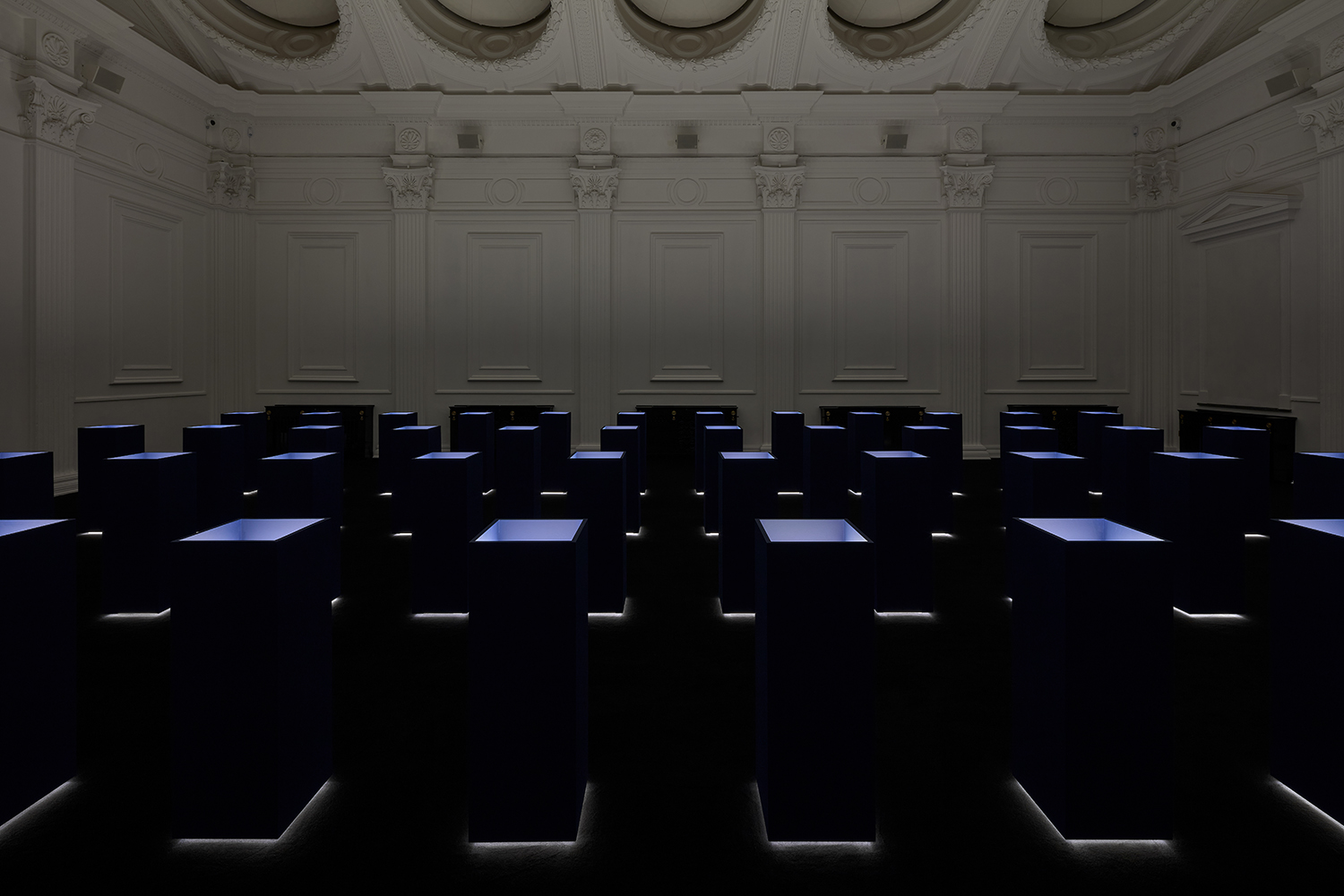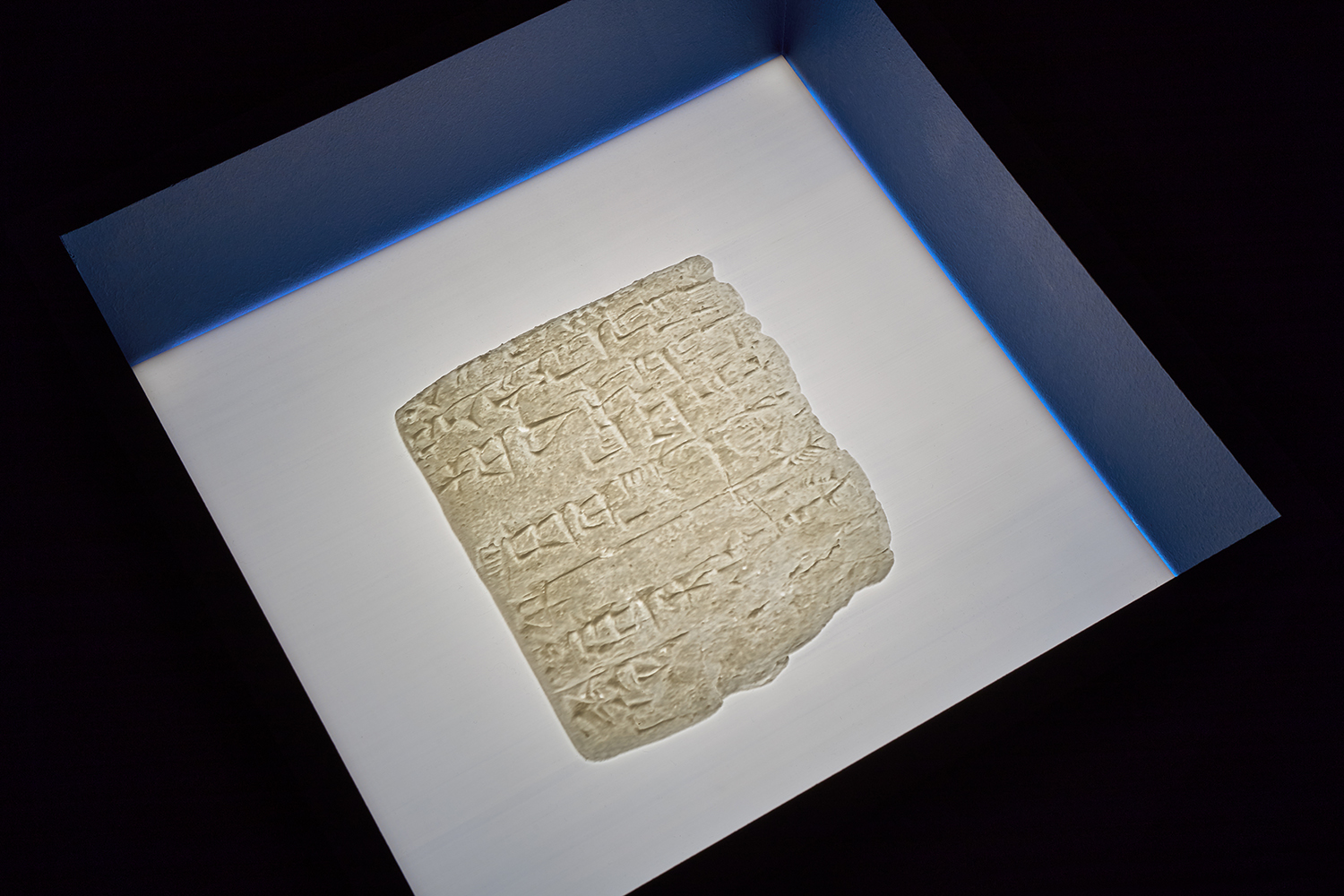


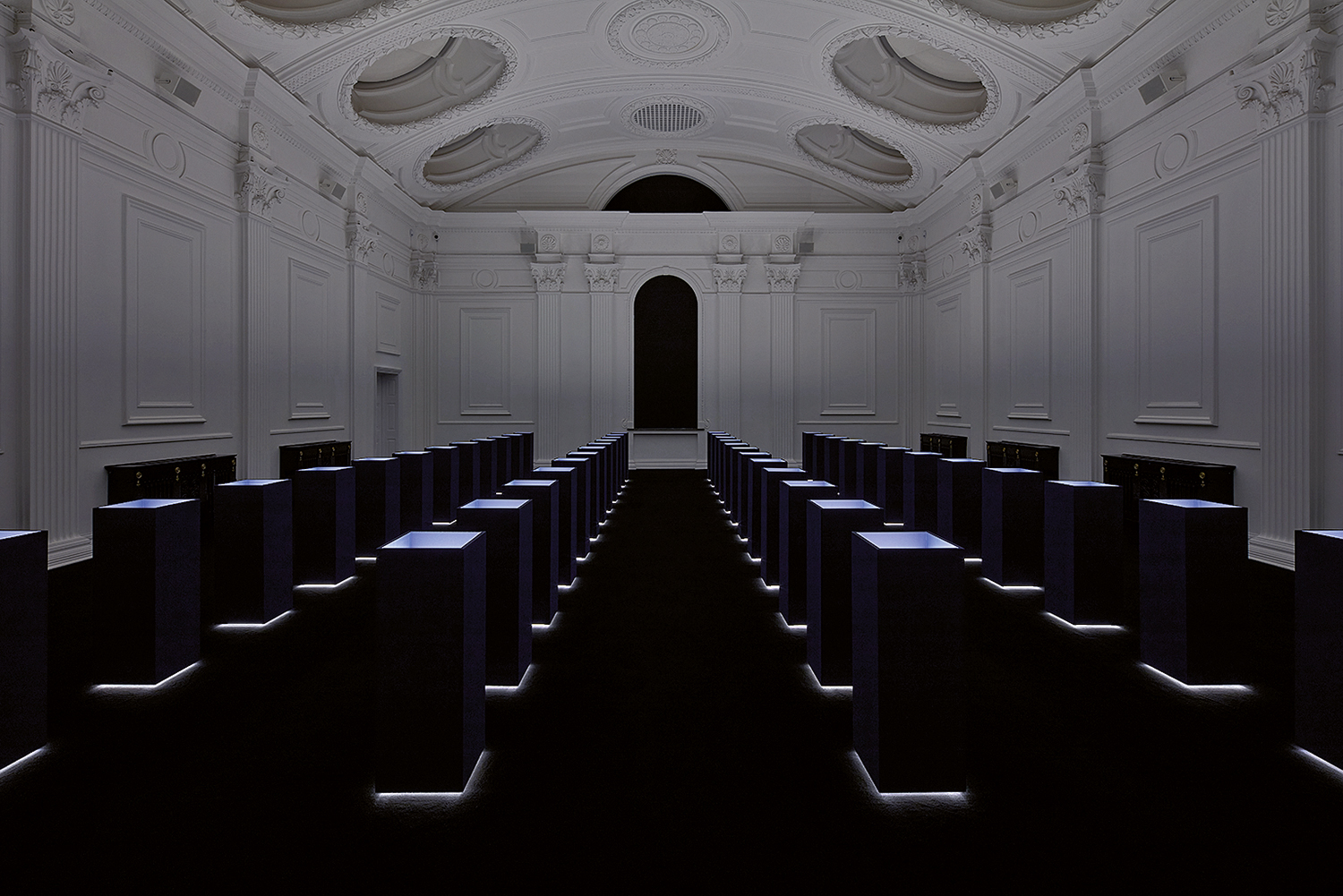
Installation view of Stolen Past by Hrair Sarkissian at Ibraaz. Courtesy of the artist and Ibraaz. Image © Ollie Hammick
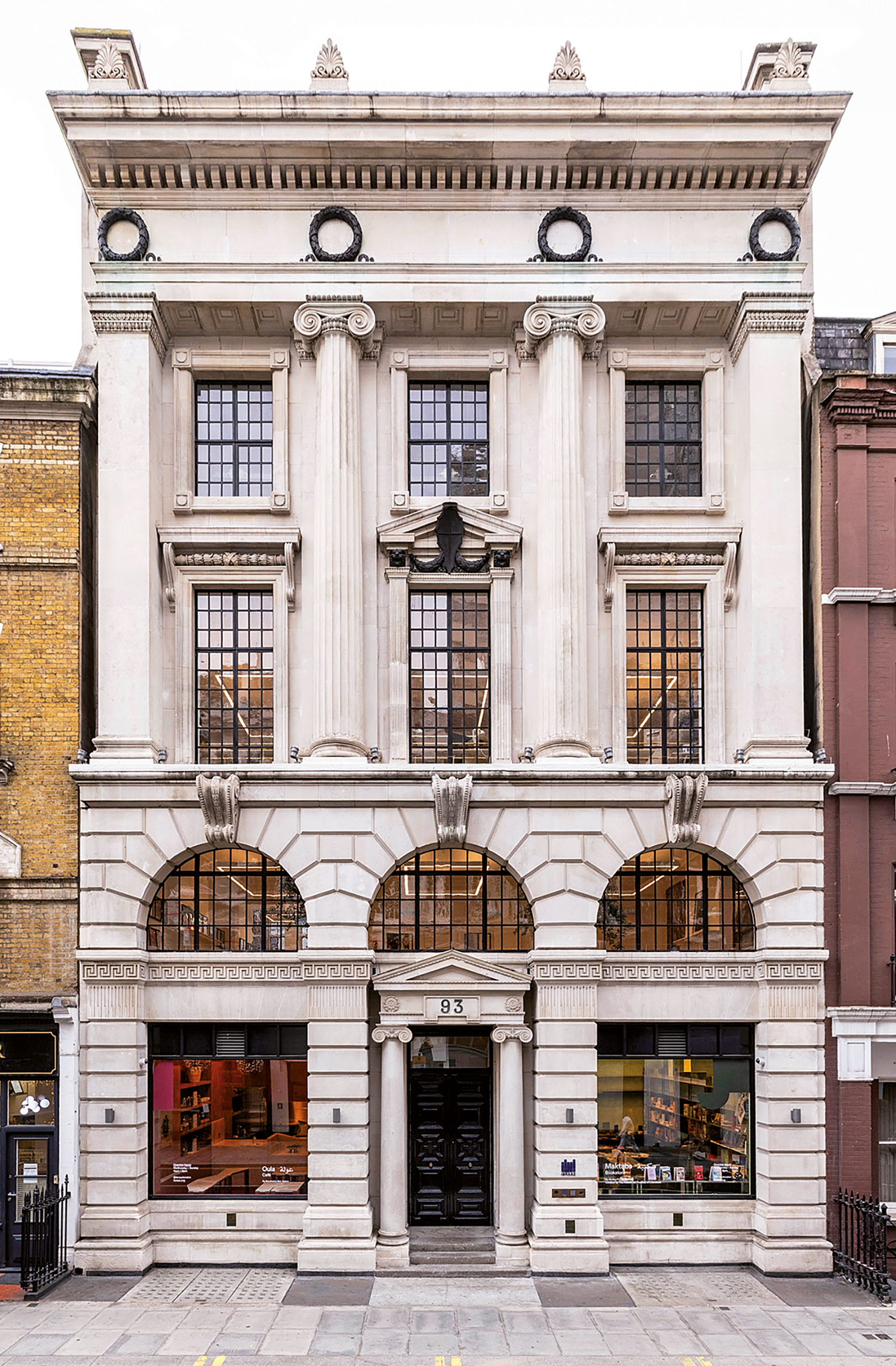
Opened in October 2025, the latest manifestation of Ibraaz is a handsome London centre and, says Hammad Nasar, director of programmes and content, its mission is in making global connections
On show in a grand vaulted room just off London’s Oxford Street this spring, Hrair Sarkissian’s Stolen Past presented images of artefacts purloined from the Raqqa Museum, Syria. 3D-printed as lithophanes, and displayed on a series of columns, the representations depicted the clay tablets, ceramic vessels and ancient figurines which vanished when the Islamic State looted the museum from 2013 to 2017. The reliefs were lit from below, light filtering through – or not – to reveal the image and give an impression of depth. Without this intense light the reliefs largely disappeared, collapsing into barely perceptible surfaces.
It was a poetic way to speak about appearance and disappearance, and as Hammad Nasar pointed out, also a fitting project for the Ibraaz centre, which supported the work as well as showing it. The director of programmes and content at the centre, he explained that Ibraaz translates as ‘to shine light on’; the centre is not focused on photography, but writing with light sits comfortably there.
In October, Gabrielle Goliath’s Elegy will arrive, a multichannel video installation mourning individuals lost to violence, including South African student Ipeleng Christine Moholane, a victim of femicide, and Palestinian poet Heba Abunada, killed in an Israeli airstrike on Gaza. Originally slated for the South African Pavilion at the Venice Biennale, this work was controversially cancelled; Ibraaz helped Goliath show it in Venice during the festival anyway, before bringing it to London. The Kamel Lazaar Foundation also helped an earlier iteration go on show in 2022 at Jaou Tunis – the biennale it founded in 2013.
“Elegy is a work that holds memory, care and connection in the face of loss,” said Lina Lazaar, founder and director of Ibraaz and vice president of Kamel Lazaar Foundation. “Carrying it forward now feels both urgent and necessary, and aligns with Ibraaz’s mission to be a brave space that platforms art and ideas from the Global Majority.”
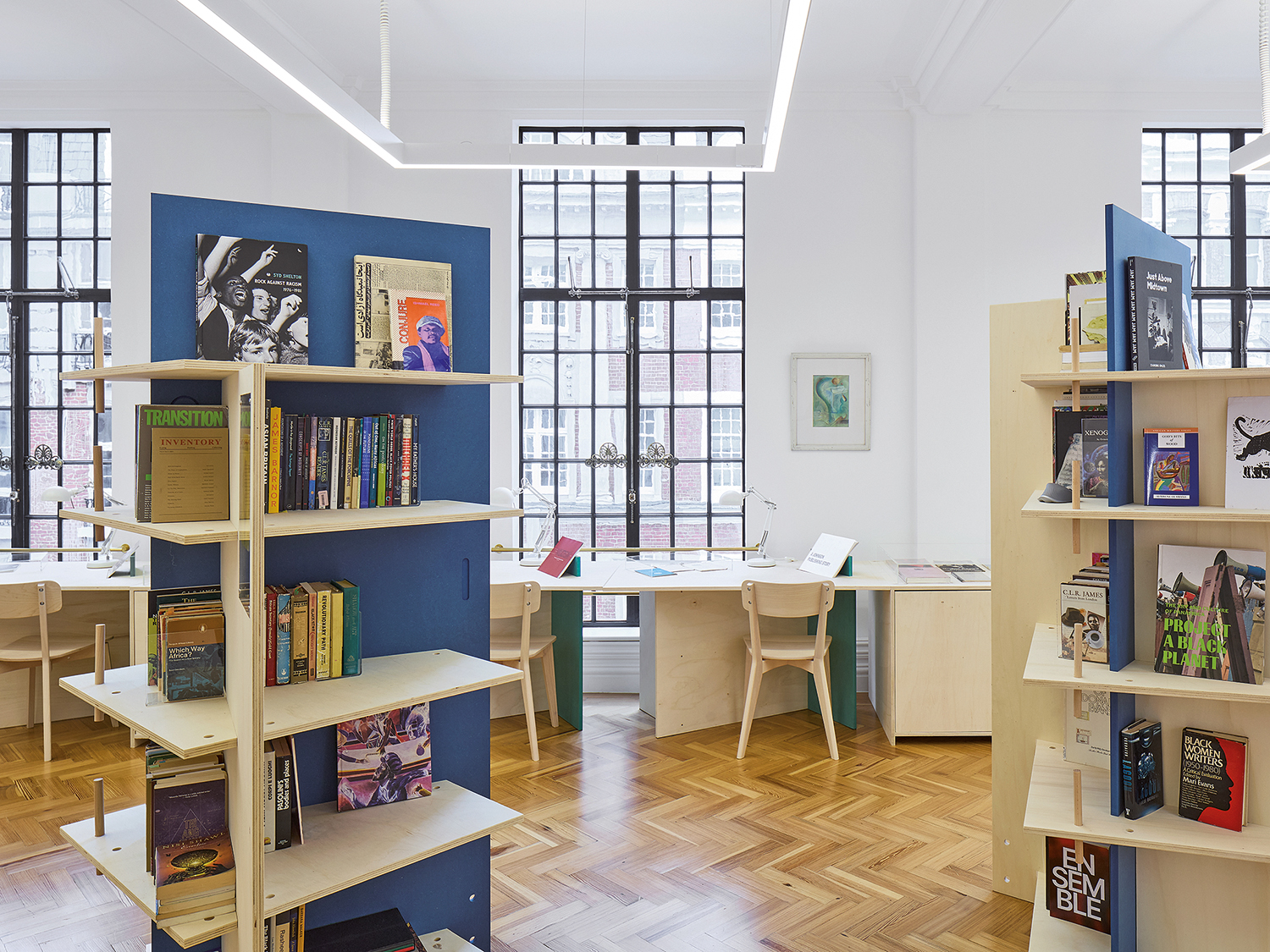
As Lazaar’s comment suggests, Ibraaz aims to be much more than a place to view art. The physical space is framed around meeting points, the exhibition space called the Majlis or ‘gathering room’ rather than a gallery. On the first floor there is a Sofra, a workshop or meeting room; above is an Iqra or library, currently hosting an installation of books and magazines collected by The Otolith Group. Its archive includes handsome photobooks such as Syd Shelton’s Rock Against Racism 1976–1981 and Stephen Shames’ The Black Panthers.
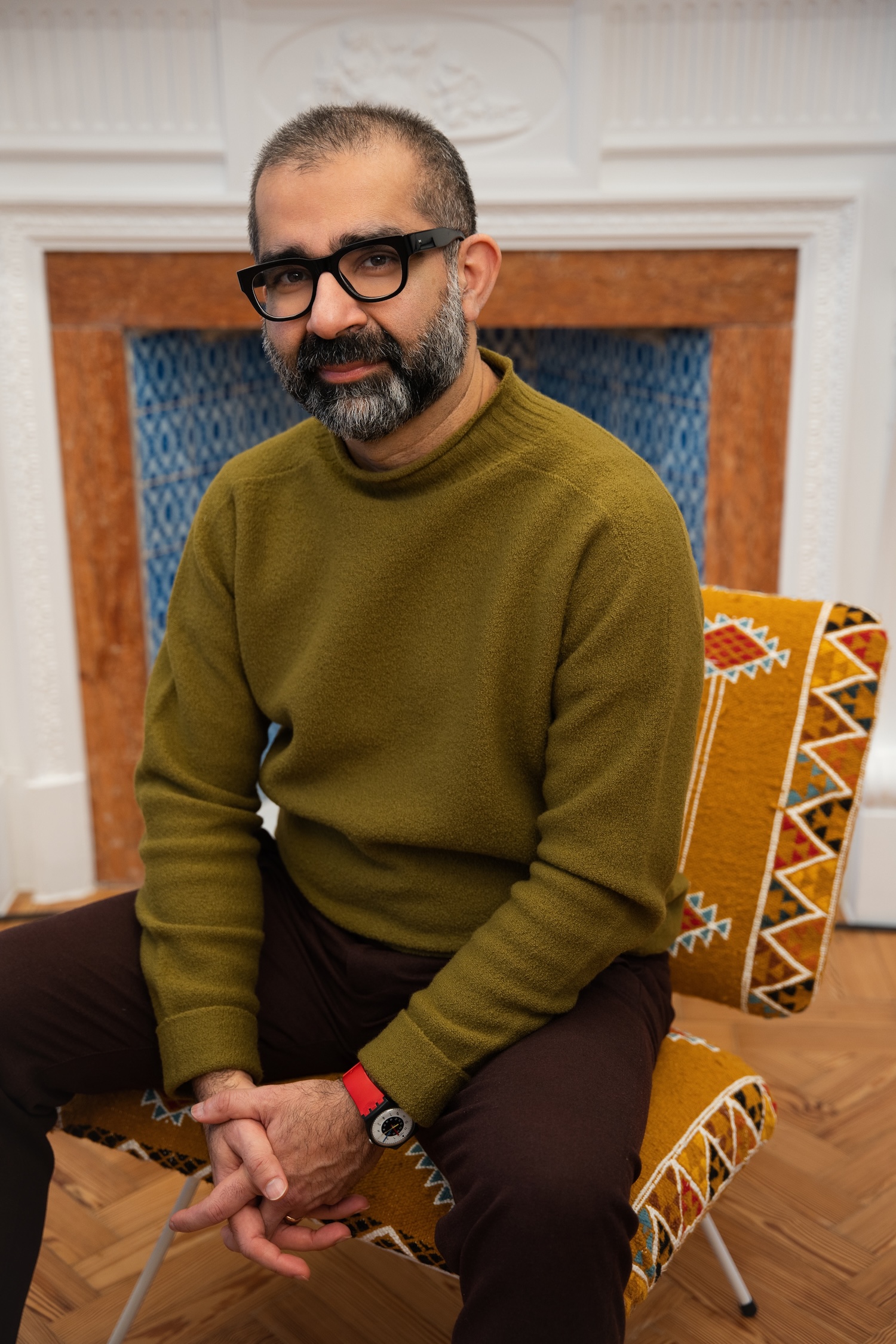
“Our ambition is not a traditional ambition for people to come and quietly admire things in a hush and then walk out. We want noise. We want conversations” – Hammad Nasar
On the third floor is a Musalla, which directly translates as ‘spiritual practice room’; when I visited it was home to Joe Namy’s Cosmic Breath, recordings from around the world of the adhan, or Islamic call to prayer. Louise Oram, head of communications and partnerships at Ibraaz, invited me to enter and listen, while explaining that the carpeted room is equally a place to pray, or reflect, or just rest from the city outside. In the basement there is a Minassa, ‘a platform, podium, dais, or stage’; this room is being used for cinema or performances, or regular discussions, talks and debates.
Conversations are also welcome elsewhere though, throughout the meeting rooms or in the welcoming Oula cafe, which is run by French-Tunisian chef Boutheina Ben Salem. The cafe is on the ground floor opposite the Maktaba, or ‘bookshop’, which is operated by Burley Fisher Books and curated by the Palestine Festival of Literature. Ahmad Al-Bazz’s photobook The Erasure of Palestine was on display in the window when I visited; Nasar urged me to look through the publication, and told me about a recent event in which Al-Bazz discussed his work in the bookshop.
“Our ambition is not a traditional ambition for people to come and quietly admire things in a hush and then walk out,” Nasar smiled. “We want noise. We want conversations… These gatherings, around food, books, the soul, or with song, with art, that’s the overall sense of the programme. That’s what we’re interested in doing.”
We were talking in the Sofra, beneath framed images of Palestine by Adam Rouhana and Adam Broomberg. Many of the works shown at Ibraaz come from the Kamel Lazaar Foundation, but Ibraaz is not a collecting institution. In fact it originally started as an online publication, launched in 2011 in response to the Arab Spring, “to create a platform where people could gather online”, said Nasar. That impulse has stayed consistent, he continued, adding that the London centre, which opened in October, aims to be “a discursive place of gathering”.
“As we see the ongoing genocidal violence in Gaza, now extending elsewhere, and as we see the spaces for gathering reducing, the spaces for free expression really under assault, these things made Lina keen to have a space where physical gatherings could take place,” he explained. “A centre to act as a vehicle or vessel to hold people.”
These factors make photography important to Ibraaz in several ways. First, as Nasar pointed out, photography and lens-based imaging are a key part of contemporary art. Second, photography’s ability to document and evidence are prized by those whose realities are minimised (or violently destroyed). Third, and closely related, photography is a democratic medium, putting the means of production and circulation into many hands. “It’s the tool within the armament that virtually every single human being has in their pocket,” said Nasar.
“Photography has the capacity to bear witness [whether a cell phone or camera],” he continued. “Think of The Erasure of Palestine. It looks at remnants of Palestine villages in occupied territories which are now being called Israel; it is actually a visual mapping.”
Closely related is the Ibraaz online platform, an integral part of the programme; it makes material, including photography, accessible to the widest possible cohort. Ibraaz Publishing commissions articles and information on topics related to events in the physical space, but it also has a rich archive of articles, interviews, films and images; it has the tagline ‘A gathering of gatherings’ and includes essays by Rasha Salti and Kristine Khouri on their travelling exhibition Past Disquiet, an archive of politically engaged, anti-imperial art and activism. It has a whole section titled Visual Thinking.
The website also expands access to Ibraaz’s in-person events, for example via transcripts of discussions at its February 2025 ‘Mission Gathering’. These conversations included Muhannad Hariri, Al Hassan Elwan, and Günseli Yalcinkaya, whose discussion was titled Online/Offline Forms of Dissemination, and included thoughts on the flow of images from Gaza since October 2023. “Internet culture is no longer an outlier to mainstream culture, but what drives it,” noted Al Hassan Elwan, later adding, “I feel like the centre is no longer physical and the centre is online or in that virtual biome.”
Still, Ibraaz is happy to have a physical home, and chose London very deliberately; the UK capital is one of two or three truly international cities in the world, explained Nasar, and one in which the Global Majority and its diaspora is in the majority (“I choose to think of the Global Majority as an aspirational position of solidarity, rather than a geography or an epidermal hue,” he smiled). He describes Ibraaz as “an intervention in the present moment”, but the initiative is an intervention in the UK cultural ecosystem too because, backed by a private foundation, it can do things other institutions cannot.
“Public funding has been going down significantly, but the demands for that funding have been rising,” said Nasar, who chairs the grants committee of the Henry Moore Foundation and who co-curated the 2020 Hayward Gallery touring exhibition British Art Show. “People have become so conservative in what they programme to avoid getting into trouble with their sponsors, to get into line with the politicians. Of course we don’t have a carte blanche here, but being supported by a foundation means we can do the programme that needs to be done.
“I often think of ethical art as the undisciplined,” he added. “How do you create an undisciplined space that doesn’t respect the boundaries, that doesn’t quack like the duck you expect? And how do you make that work accessible for people? We’re thinking about this in an ambidextrous way as we curate the website and edit the building.”