
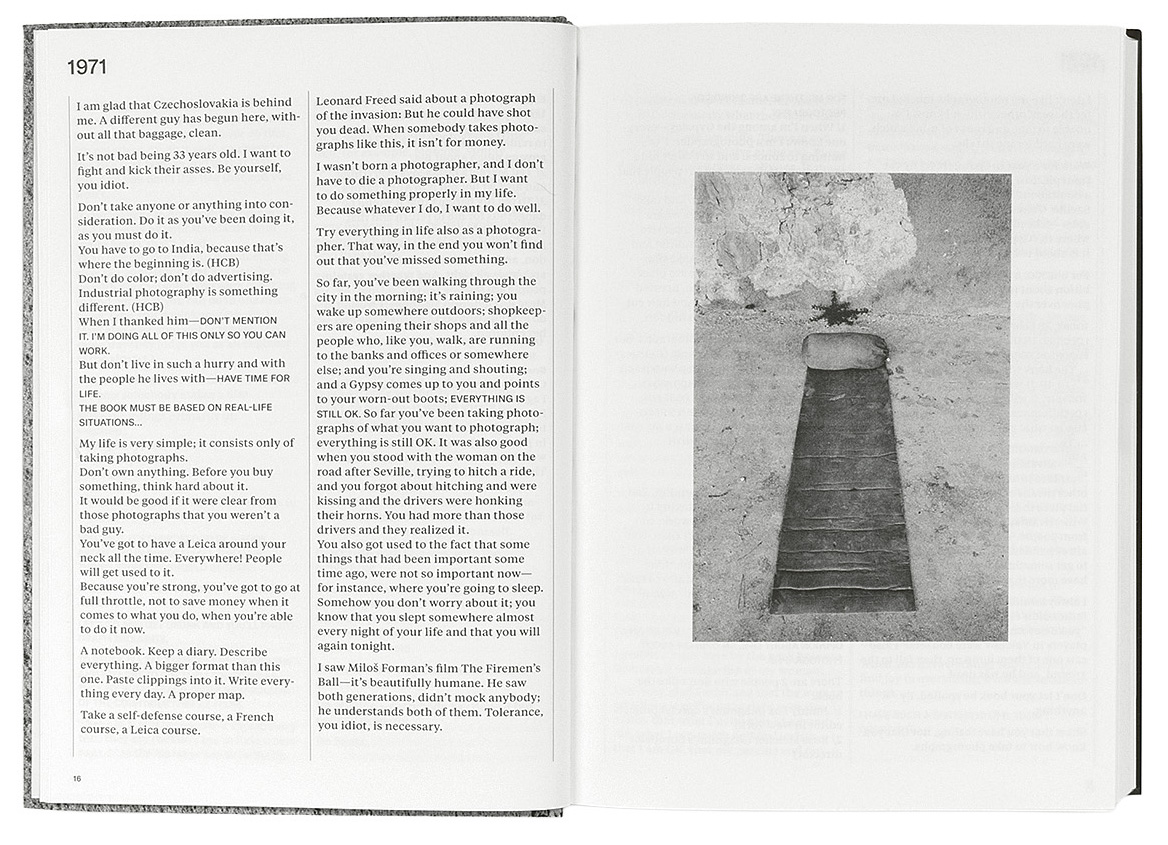
Spread from Josef Koudelka: Diaries.
The collected journals of the artist look at his life in exile and celebrated images
First coming to international attention as PP – ‘Prague Photographer’ – after anonymously publishing images of the Soviet invasion of Prague in The Sunday Times in 1968, Josef Koudelka went on to gain mythical status. Fleeing Czechoslovakia, and becoming a member of Magnum, he embarked on an itinerant life, travelling widely with very few belongings, part inspired by photographing the Roma people, with a camera, a sleeping bag and little else. Koudelka made sacrifices to lead what he termed “the vagabond life” and become the photographer he wanted to be; it sounds romantic, but these extracts from his diaries give an insight into what it took.
Koudelka encourages and cajoles himself, sometimes in shouty capitals; some themes recur over and over, suggesting it is harder than expected to “AVOID THE COMFORT OF GOOD BEDS, FOOD, CARS”. Some of the notes are dryly funny, such as the repeated complaints about attending Les Rencontres d’Arles, where the “circus” of networking and parties diverges far from Koudelka’s conception of a photographer’s life (though he returns and also exhibits there). Some of his notes are more poignant, suggesting bigger blows and journalling as a way to handle them. “I love her, but what is probably more important for me is taking photographs,” he notes halfway through. A little later he adds; “So, in 5 mins your woman Jill and your daughter Lucina should land. After 3 months, it seems to you that they don’t even exist.”
“I love her, but what is probably more important for me is taking photographs,” he notes halfway through
There are no doubt further insights – and complaints – in his unedited diaries, and this version is also translated from the many languages he originally wrote in; but there is much to learn about Koudelka’s working process as well as his life. He makes detailed plans for exhibitions and books, and reflects on the changing industry; Koudelka considered magazines’ days numbered, even when the editorial market was buoyant compared to now. There are notes about printing and scanning, and Koudelka’s preferred approach to tones; there should be at least one place in the photograph where it is white, and one place where it is black he asserts, more than once.
The text is also peppered with images Koudelka took along the way – not the shots for which he became celebrated, but more diaristic and even emotional photographs, showing himself, his feet or his shadows, and the humble spots for his solo sleeping bags. “For 20 years I have been traveling,” he reflects. “Perhaps I can define it like this: Home is where I am now. I carry my home with me.”